
Crucial Conversations: Navigating High Stake Conversations at Work

Camille Bradbury is Editor-in-Chief of HRinsidr, where she translates evolving compliance and employment law developments into practical guidance for HR leaders. She has partnered with entrepreneurs, corporate teams, nonprofits, and government agencies to navigate legal complexity and operational growth, supporting organizations from early-stage startups to multimillion-dollar enterprises. Her work focuses on helping HR lead high-stakes people decisions with clarity and confidence.
—
High-stakes conversations are a reality at work, yet most leaders are never given the tools they need to handle them well. Tools that help us communicate calmly and clearly can be a true game changer.
Crucial Conversations is a dialogue framework that teaches people how to calm their emotions and stay focused on the heart of the matter during high-stakes discussions. The technique helps us address controversial topics while maintaining respect for one another. The New York Times bestseller, Crucial Conversations has been widely used in Fortune 500 companies, government agencies, and corporations across the nation.
Communication often goes sideways when we are under immense stress, whether from work or home. For employers, using the Crucial Conversations model can provide a helpful framework, especially because these types of conversations can significantly impact workplace culture.
What Are Crucial Conversations?
Crucial conversations share three characteristics: high stakes, strong opinions, and high emotion.
During high-stakes conversations, our emotions can cloud our judgment and cause us to create a story about the situation. We then react to that story rather than to the facts. As a result, we pursue a completely different course of action based on an emotional response. Once you understand this dynamic, it becomes clear how common it is.
When pressure and strong opinions enter the conversation, we often stop contributing useful information that would move the dialogue forward. Instead, we shift our focus toward winning, punishing, or keeping the peace. These reactions are typically driven by our emotional responses.
Calming Down Before Talking
Before engaging in a crucial conversation, it’s important to slow down our emotional response and re-center ourselves.
The Shared Meaning
The process begins by contributing information to what the authors call the shared pool of meaning. When people freely share different perspectives with honesty and respect, a psychologically safe environment is created.
Patrick Lencioni, in Overcoming the Five Dysfunctions of a Team, notes that employees closely watch how disagreement is handled. When retaliation occurs, people begin to self-preserve and remain silent.
Sharing the Same Purpose
Both parties must share the same intention. This allows difficult conversations to remain focused instead of drifting into personal attacks or “always” and “never” accusations.
Two people engaged in a crucial conversation should ultimately want the same thing: resolution.
Achieving this requires examining our own thinking patterns and catching them before they escalate. Often when conversations go wrong, it’s because our intentions shift as the dialogue continues. These changes can be subtle and easy to miss.
Mutual Respect
Mutual respect is essential in these conversations. The way we deliver our message matters just as much as what we say. Respectful communication prevents the conversation from escalating into conflict.
Much of this work happens internally. In stressful situations, our brains often shift into fight-or-flight mode. Adrenaline increases, which can hijack our ability to think clearly and communicate effectively. When this happens, dialogue quickly becomes unsafe.
The Crucial Conversations model helps us calm our physical response so we can approach the situation more thoughtfully and achieve the outcome we want. The goal is to be 100 percent honest and 100 percent respectful. This requires self-awareness, tact, and a willingness to shift away from our default reactions.
When emotions take over, we may speak from a place of hurt, which can make the conversation confusing or unproductive. Practicing this model involves regaining control of our emotional state through a process called self-inquiry.
Self-inquiry signals to the brain that there is no physical threat, allowing blood flow to return to the logical parts of the brain rather than fueling the fight-or-flight response. When this happens, rational thinking returns and we can respond more appropriately.
A Workplace Example
The authors of Crucial Conversations share an example of a CEO who wants to build the company’s next office in his hometown, even though the West Coast would be more economical.
Most employees might stay silent to avoid challenging leadership. However, one employee respectfully offers a different perspective. Because the feedback is delivered with respect, the CEO is able to hear the alternative without becoming defensive.
This is why it’s important for leaders to model healthy responses when employees speak up. Leaders set the tone for the culture and determine whether open communication feels safe.
The Crucial Questions
Intentions form the foundation of a crucial conversation. To keep intentions aligned, the model encourages asking a central set of questions:
- What do I really want here?
- What outcome am I seeking?
- Am I behaving in a way that supports that outcome?
If the answer is no, it’s time to return to self-inquiry.
The Successful Elements of Crucial Conversations
Avoid the Fool’s Choice
A common trap during high-stakes conversations is falling into what the authors call the Fool’s Choice. This happens when we believe we must choose between two extremes.
For example, we may think we must either achieve results or preserve the relationship. This type of black-and-white thinking shuts down dialogue.
People who are skilled at crucial conversations understand that dialogue is always an option.
When Dialogue Becomes Unsafe
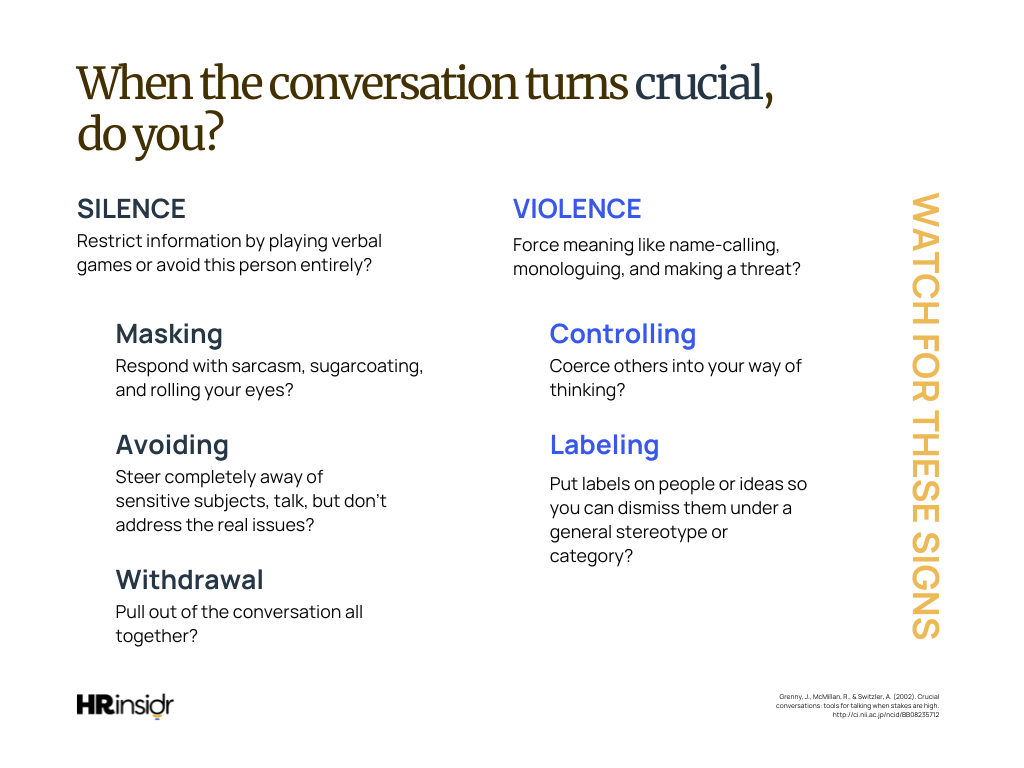
When people stop contributing information and retreat into silence or aggression, the conversation has become unsafe.
Silence might show up as withdrawing from the discussion, avoiding eye contact, or refusing to engage. Aggression might appear as sarcasm, eye-rolling, or passive-aggressive comments.
A common workplace example occurs when employees suddenly become quiet in a meeting after a leader announces a decision they disagree with. High stress triggers automatic reactions that prevent meaningful dialogue.
Questions to Break out of the Fool’s Choice:
Take the Crucial Conversation Style Under Stress Assessment!
One way to break out of the Fool’s Choice is by returning to the core questions of the conversation.
For yourself:
What do I want for myself?
What do I want for the other person?
What do I want for this relationship?
To clarify with others:
What I don’t want is _______.
What I do want is _______.
These questions encourage deeper thinking and move the conversation away from automatic stress responses.
People become defensive when they no longer feel safe. At that point, the conversation shifts from discussing the issue to managing the tension in the interaction itself.
When people believe others have their best interests in mind, defensiveness tends to decrease. Respectful communication signals that shared intention.
In many workplaces, employees hold back their opinions rather than risk upsetting someone in a position of authority. When this happens, the team becomes less invested in the final decision.
On the other end of the spectrum, people may respond with violence rather than silence by pushing their own point of view aggressively. This approach also prevents collaborative solutions.
Get Your Team Started
Integrating Crucial Conversations
Crucial Conversations provide a framework for bringing dialogue back to safety. Psychological safety has become one of the most important factors in preventing toxic workplace cultures.
Clarifying meaning is essential to avoid assumptions and misinterpretations, especially in workplaces where vulnerability can feel risky.
Mutual respect also plays a central role. When civility breaks down, productive dialogue disappears.
Under stress, our amygdala can hijack our thinking, triggering a fight-or-flight response that prevents clear communication. The Crucial Conversations model encourages us to pause, manage our physical reaction, and separate facts from the stories we tell ourselves.
When we learn to regulate that response, we are far more capable of navigating difficult conversations and reaching productive outcomes.
 News & Compliance
Washington proposed a per-hire immigration fee larger than most salaries, the labor board's top lawyer published her hit list, and Connecticut's omnibus workforce act starts running October 1. Two federal appeals courts landed on the same theme: what an employer writes after a complaint can matter more than the decision itself.
-
News & Compliance
DHS extended a $4,000 fee to routine H-1B extensions, and $4,500 to L-1s. Massachusetts and Illinois each added new employer reporting duties. A Fourth Circuit decision sharpened what the Americans with Disabilities Act demands when an employee asks for reassignment. Here are four developments for your fall planning.
-
News & Compliance
State agencies are locking in 2027 pay floors. At the same time, Congress and the federal courts are redrawing where federal labor law reaches and what employers owe employees who never asked for help.