
HR Leaders Are Breaking. Here’s Why Nobody Notices

Dr. Tamara Stallings is an organizational psychologist, senior HR leader, and Professional Certified Coach (ICF PCC) with 20+ years of experience leading people strategy and organizational effectiveness. Her doctoral research examined the relationship between employee resilience and post-traumatic growth in HR leaders. She is the founder of the Workforce Evolution Institute and the author of the Burn The Handbook™ newsletter, published on LinkedIn, which reaches 2,000+ HR professionals with evidence-based insights for bold leadership.
—
HR has a people strategy for everyone—except itself.
That’s not an oversight. It’s a design flaw.
Ninety-five percent of HR leaders say the role is overwhelming due to excessive workload and stress. Eighty-one percent report feeling burned out. Fifty-nine percent of healthcare workers are stressed by burnout in 2025, nearly double the 32% reported in 2018.
These aren’t statistics about the workforce HR serves. These are statistics about HR itself.
Who Is Carrying the Carrier?
HR professionals are the designated shock absorbers of organizational life. When the workforce is anxious, they steady it. When leaders make difficult decisions, they manage the fallout. When employees experience trauma (layoffs, restructuring, harassment, grief), HR is the first call.
They carry the institutional weight of every person in the building. Often simultaneously. Often without acknowledgment. And almost always without a people strategy of their own.
Who is carrying the carrier?
And in most organizations, the answer isn’t unclear. It’s uncomfortable. No one is.
Beyond Burnout: What My Research Reveals
HR leaders don’t just witness organizational trauma. They absorb it.
Most burnout conversations end at “resilience,” encouraging HR leaders to be stronger, more boundaried, more self-aware. The advice is well-meaning but incomplete.
My doctoral research in organizational psychology found something the resilience literature often overlooks: Resilience alone is not enough.
What separates HR leaders who break from those who breakthrough is Posttraumatic Growth (PTG), the capacity to be genuinely transformed by adversity rather than merely surviving it.
PTG is not toxic positivity. It is not pretending difficulty isn’t real. It is the documented phenomenon (grounded in 30+ years of psychological research) where people emerge from high-stress periods with:
- Expanded perspective and clarity about what matters
- Deeper, more authentic relationships
- Recognition of new possibilities they couldn’t see before
- Greater personal strength and confidence
- Richer appreciation for their work and life
HR leaders are uniquely positioned to experience posttraumatic growth. The question is whether organizations create the conditions for it or actively prevent it.
The Three Warning Signs You’re Performing Resilience, Not Experiencing It
Sign 1: You’re Exhausted—But Can’t Point to a Single Task That Caused It
If you can’t name what drained you but Sunday night fills you with dread rather than readiness, your body is telling you something. Burnout disguises itself as dedication. The first step is honest recognition: of the weight you’re carrying, the cost it has, and the signals your body and behavior are already sending.
Sign 2: You’re Managing Perceptions, Not Managing Work
When significant energy goes toward translating yourself, navigating unspoken dynamics, or managing how you’re perceived rather than doing your actual job, you’re paying an invisible tax. This is emotional labor without compensation, and it compounds over time.
Sign 3: You Feel Like You’re Performing Resilience Rather Than Actually Experiencing It
There’s a difference between being resilient and performing resilience. One is sustainable. The other is theater. If you’re checking the boxes (meditation app downloaded, boundaries “set,” self-care Sundays scheduled) but still feel hollow, you’re likely performing rather than recovering.
The PTG Leadership Shift™: From Barrier to Breakthrough
In my research with HR leaders navigating burnout, I developed a three-stage framework (the PTG Leadership Shift™) that distinguishes those who merely survived from those who transformed:
Stage 1: Recognize
Name what is happening without minimizing it. Write down the three things costing you the most energy right now. Not work tasks. The invisible labor. Name it without judgment. Recognition without action is awareness. But without recognition, there can be no action.
Stage 2: Reframe
Shift from barrier mindset to breakthrough orientation. This is not about gratitude journaling or silver linings. It’s about deliberately reconstructing how you interpret adversity, from something happening to you, to something that is shaping and informing your next chapter.
Ask yourself: What is this season teaching me about the leader I’m becoming? What possibilities exist now that didn’t before?
Stage 3: Rebuild
Design systems for sustainable resilience. Peer support structures. Executive coaching. Organizational enabling conditions. Intentional recovery. Not as afterthoughts, but as strategic investments in your most important leadership asset: yourself.
HR leaders who experience posttraumatic growth don’t just recover from burnout. They redesign the conditions that created it.
The Data That Should Make Us Uncomfortable
95% of HR leaders feel overwhelmed (Sage, 2024)
84% experience significant stress (Sage, 2024)
81% report burnout (Sage, 2024)
90% cite limited budgets as a top stressor (Sage, 2024)
89% cite inadequate team resources (Sage, 2024)
$4.6 billion: annual cost of burnout to U.S. healthcare system (AMA)
These numbers should make every organization uncomfortable. Because when HR breaks, the entire people strategy breaks with it.
What Organizations Get Wrong
Organizations don’t ignore HR burnout because they don’t care. They ignore it because HR has been conditioned to absorb it.
Most organizations treat HR leader burnout as an individual problem requiring individual solutions: “Take a wellness day. Set better boundaries. Practice self-care.”
But burnout is not an individual failure. It is a systems failure.
When 95% of HR leaders are overwhelmed, that is not a personal resilience issue. That is an organizational design flaw.
The organizations that successfully support HR leaders don’t just offer Employee Assistance Programs. They fundamentally redesign the conditions under which HR operates:
- Adequate resourcing: not as a nice-to-have, but as a baseline
- Psychological safety: where HR can say “I don’t have capacity for that” without career consequences
- Peer support structures: formalized, not informal
- Executive sponsorship: where the C-suite actively protects HR’s capacity
- Strategic investment: in HR’s development, not just HR’s output
The Question Every HR Leader Should Ask This Week
If I designed a people strategy for someone in my exact role, under my exact conditions, with my exact constraints, what would I build?
Then ask the harder question: Why am I not building it for myself?
Three Actions You Can Take This Week
1. Name It
Write down the three things costing you the most energy right now. Not work tasks. The invisible labor, the perception management, the emotional absorption. Name it without minimizing it.
2. Tell Someone
Share your experience with one trusted person: a peer, a coach, a mentor. Breaking isolation is the first act of posttraumatic growth. You cannot transform what you’re unwilling to acknowledge.
3. Invest in Yourself
Schedule one hour this week that is specifically for your own development. Not your team’s, not your organization’s. Yours. Treat it with the same seriousness you’d treat a CEO’s calendar block. Because you are the CEO of your own capacity.
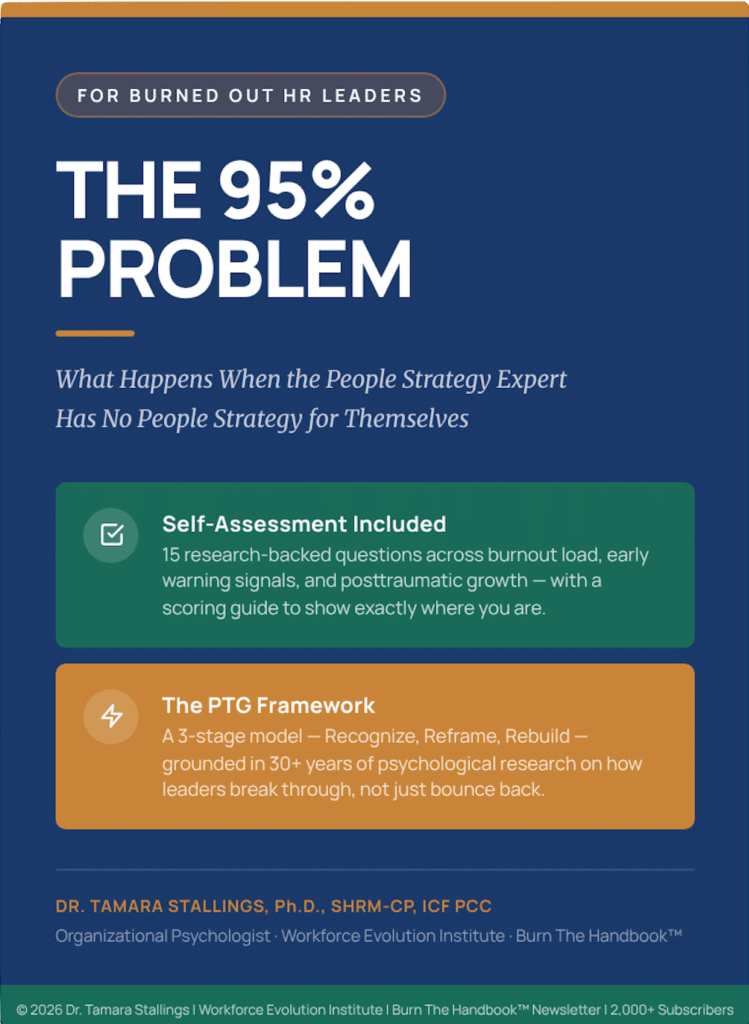
Download the assessment
The Invitation
You were never meant to carry the organization alone. You were meant to help redesign it.
Not because you’re weak. Not because you failed. But because the system was never designed to be sustainable, you deserve better than surviving.
Posttraumatic growth is possible. But it requires honesty about where you are, courage to redesign what isn’t working, and community to remind you that you’re not alone in this.
Continue the Conversation
Join 2,000+ HR leaders who receive Burn The Handbook™, a biweekly research-backed newsletter for bold leaders who refuse to manage by myth. Subscribe or connect with Tamara.
The information contained in this site is provided for informational purposes only, and should not be construed as legal advice on any subject matter.
 HR Profession
On his podcast The Business of Alignment and through his sales-intelligence operation Pulse HR, AJ Vaughan has had more than 1,000 conversations with CHROs, founders and HR tech leaders about what makes organizations work. Here are the 5 things he can't do his job without.
 Compensation and Benefits
Last week we asked how much of your 2027 health increase you're planning to pass along to employees, and the most popular answer was none of it. Here's why we think you answered that way.
 News & Compliance
The NLRB confirmed its standard for disciplining misconduct during protected activity, California signed 4 workplace technology laws, and a second federal court blocked the policies behind the $100,000 H-1B payment. California's first deadlines arrive January 1.